Designing the Future: Lessons from Zalando’s Design Academy Nova
In May this year, I became one of the participants in Design Academy Nova, an educational program organized by Zalando and VORN. This 8-week course focused on innovative materials, the circular economy, honest and transparent branding, as well as inclusivity in the fashion industry. For me, as a clothing designer and brand owner, it was very productive and informative.
Exploring Innovative Materials
The program allowed me to get acquainted with companies that are engaged in the development of innovative materials (fabric and leather made from pineapples, fabric made from agricultural products, plants that were not originally grown for fabric production, viscose obtained by recycling textile waste, 3D-printed accessories for clothing and bags, etc.).
We were also introduced to the company Circ, which has learned how to separate polyester and cotton in blended fabrics, making it possible to subsequently recycle these materials and obtain new fabrics (lyocell viscose and polyester) for further use.
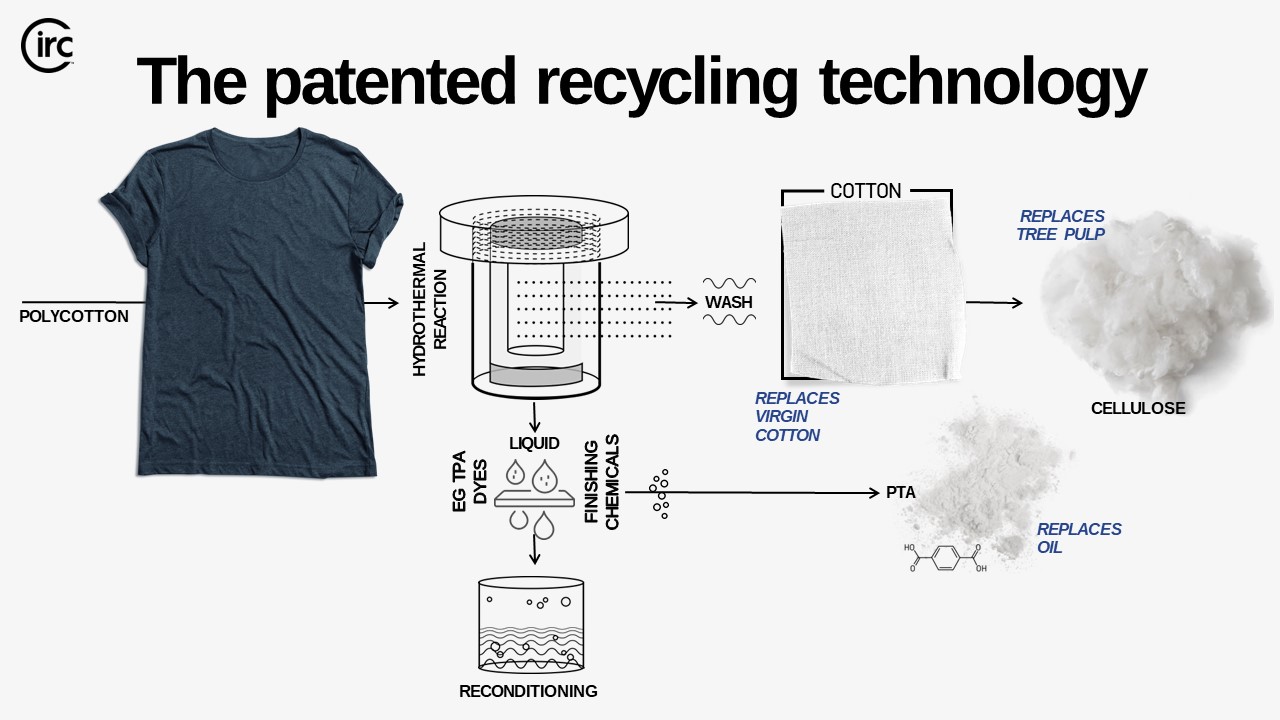
Image from Circ Technology website
We were also introduced to TURNS, a service for collecting and recycling clothing and textiles that have reached the end of life cycle.
All of this helps reduce waste and save resources.
In this course, I became convinced that traditional business models, such as fast fashion, the scarcity model (destroying unsold stock to maintain exclusivity — Burberry), exclusive identity (limiting the target audience by beauty or size standards — Victoria’s Secret), and physical retail only (no online presence) are becoming obsolete under pressure from government regulation, consumer expectations, and environmental goals. We were offered alternative business models that are more in line with modern challenges, and as it turned out, since the brand’s inception, I have adhered to some of them, namely, I use local production and custom manufacturing to shorten supply chains and reduce overproduction.
During the lectures, we discussed other methods of clothing production that would allow for more sustainable products. Much attention was paid to the choice of materials, because at the moment, of all the clothing produced in the world, only 15% is collected for recycling, and only 1% is recycled into new clothing, partly because we do not yet have simple and cheap technologies for recycling textiles. The industry understands how to recycle 100% materials, such as 100% cotton, linen, nettle, even viscose and polyester, but it is much more difficult to recycle blended fabrics, which make up the majority of the market. The difficulty lies in learning how to separate cotton from polyester and send them for recycling separately in a fabric that consists, for example, of 70% cotton, 25% polyester, and 5% elastane. This is one of the main challenges for startups working on material recycling. The first stage is learning how to separate materials for subsequent recycling, and the second stage is how to reduce the cost and scale up this process so that it becomes accessible to the mass consumer.
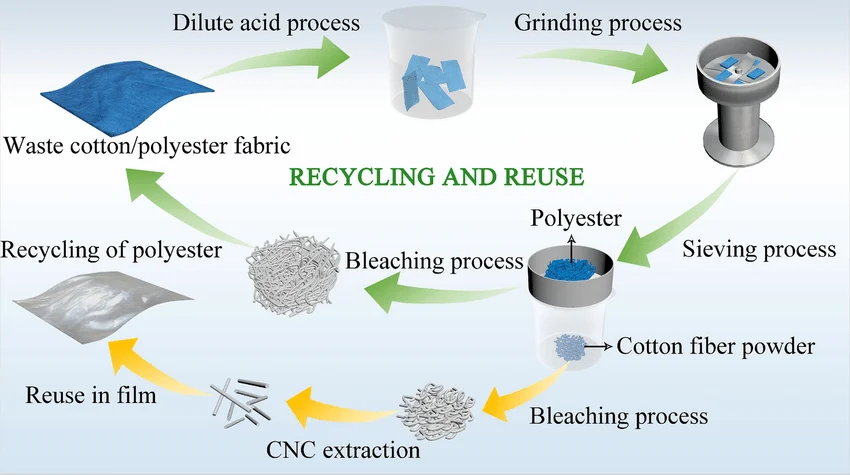
Image from Efficient recovery of the dyed cotton–polyester fabric: cellulose nanocrystal extraction and its application in composite films, Cellulose Journal
Well, while tech startups are solving these problems, as a manufacturer, I can choose 100% fabrics that are already easier to recycle and decompose faster (if they are natural fabrics). And custom sewing allows me to avoid producing anything unnecessary.
I consider myself very lucky to be one of the participants in this course. It helped me update the information I already had about materials and technologies, as well as learn a lot of new things about the current state of the industry. This course has once again convinced me that the business model I chose seven years ago is now more relevant than ever. I have outlined possible paths for development, taking into account the new knowledge and challenges I face as a designer and clothing manufacturer. Now all that remains is to bring these new ideas to life.